
Richland Parish Criminal Court Records
A criminal court record is the court case file kept once formal criminal charges are filed. In Richland Parish, the Clerk of Court's Criminal Department receives formal charges from the District Attorney's Office for offenses occurring in the parish. The department handles felony charges under the Louisiana Code of Criminal Procedure and maintains records such as bills of information, indictments, motions, orders, minutes, subpoenas, bond-forfeiture notices, evidence introduced by either side, and imaged filings.
The official Clerk Criminal Department component identifies the local department that receives and maintains Richland Parish criminal court records.
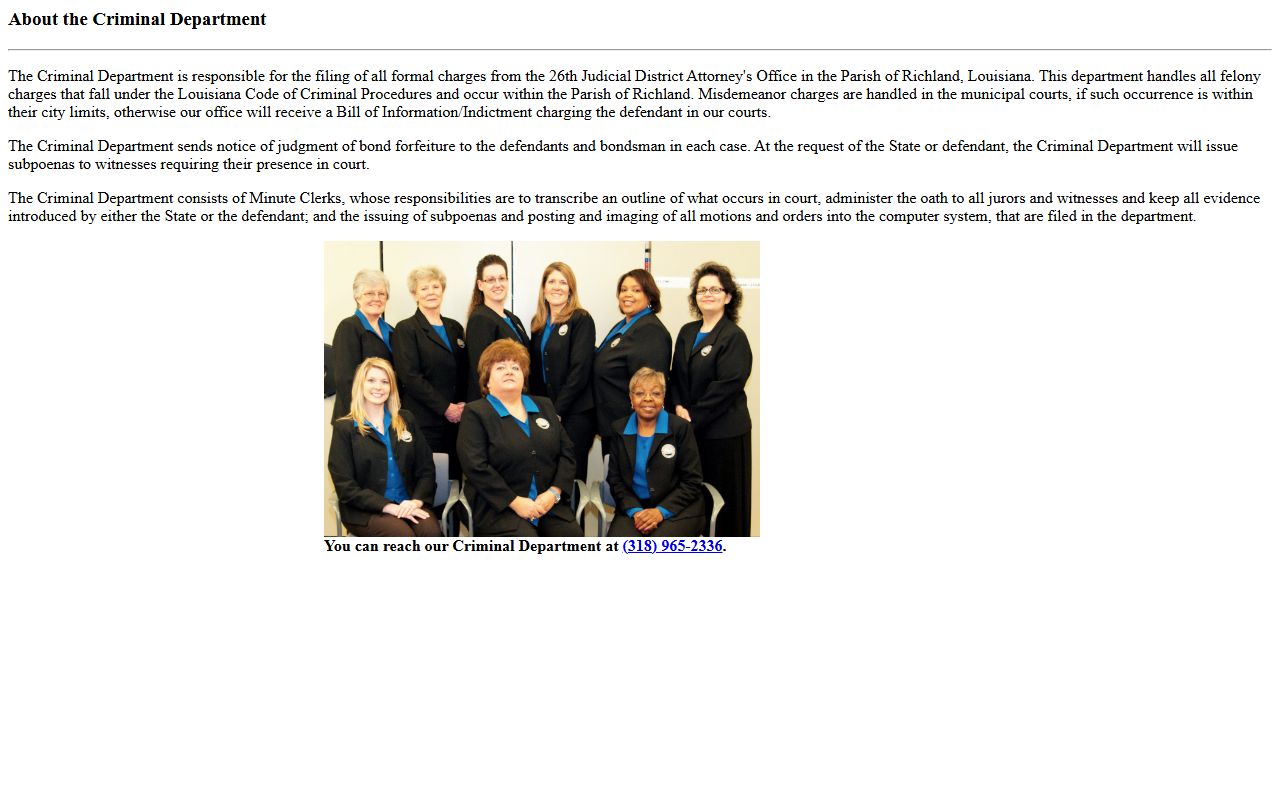
That department source anchors the distinction between a court case file and a sheriff booking or arrest record.
Richland Parish is part of the Fifth Judicial District Court, which also covers Franklin Parish and West Carroll Parish. Felony matters are handled in the district court after the District Attorney files formal charges. Misdemeanors follow a local routing rule from the Clerk's official criminal page: if the offense occurred inside city limits, the misdemeanor may be handled in municipal court; otherwise a bill of information or indictment is filed in district court. That split matters when a criminal court record is not found in the district court path.
Search Richland Parish Criminal Court Records
The official sources reviewed do not show a public, full criminal case database for Richland Parish district court. Criminal court record access is therefore based on Clerk department requests, case identifiers, payment portal clues, and the correct court level. The Richland Parish Clerk Criminal Department is the local source for formal felony filings, minutes, motions, orders, subpoenas, and evidence records. Payable criminal costs may also appear in the Richland court fine and cost payment portal when a valid case or person match exists.
The public route for the same department is also visible through the Clerk Criminal Department page on the official Clerk site.
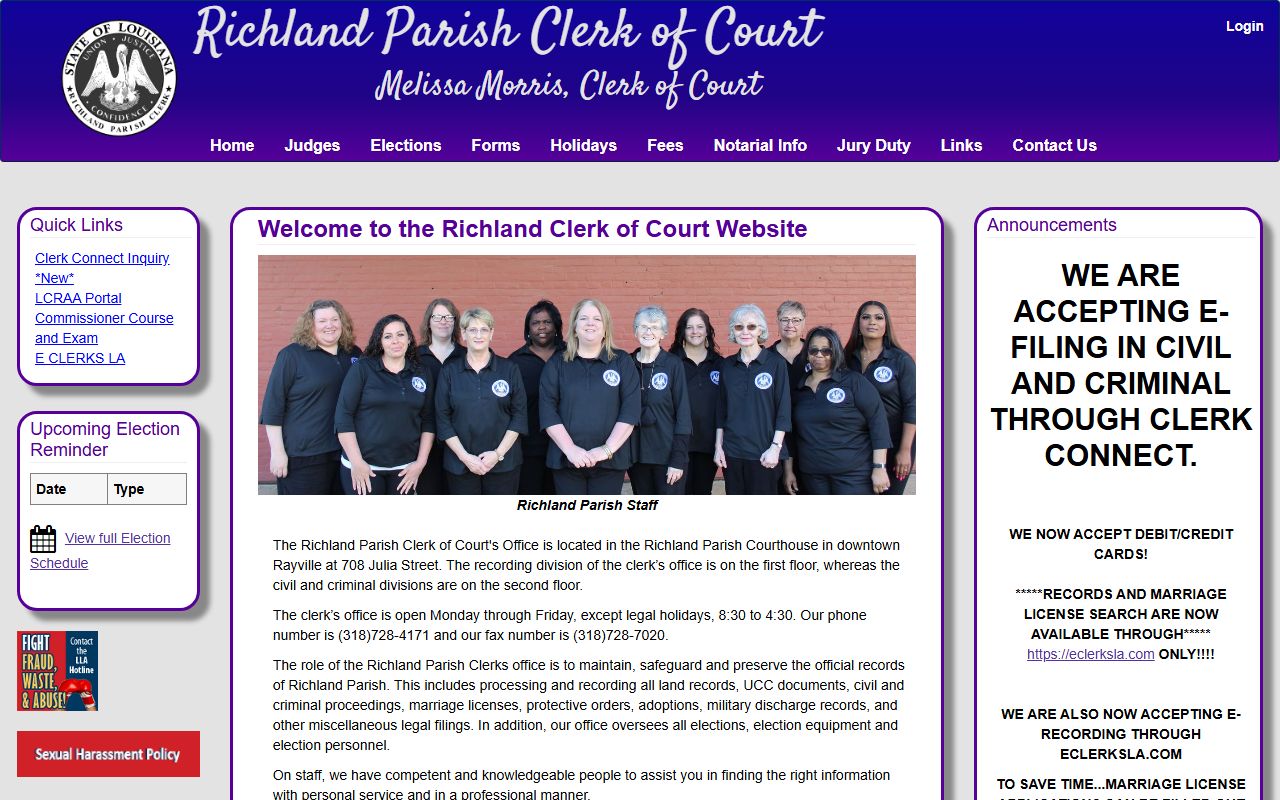
The public route reinforces that criminal court record requests should start with the Clerk when the file is a court case file.
- Confirm whether the matter is a felony district court case, a municipal misdemeanor, a traffic-related criminal matter, or a sheriff record.
- Search the payment portal only when the issue may involve payable court fines or costs tied to a case number or defendant identity.
- Contact the Clerk Criminal Department for the full criminal case file, docket, minutes, motions, orders, subpoenas, or disposition records.
- Use the municipal court named on the citation, notice, or arrest paperwork when the Clerk indicates the misdemeanor occurred inside city limits.
- Request a certified copy from the Clerk when the record will be used for court, employment licensing, expungement, or another formal purpose.
Federal criminal cases are separate from Richland Parish criminal court records. Federal prosecutions are searched through the U.S. District Court for the Western District of Louisiana, CM/ECF, and PACER. State appeal records from district court route through the Court of Appeal, Second Circuit in Shreveport.
Richland Parish Criminal Case Flow
A criminal court record grows as the case moves from formal charge to final outcome. The District Attorney screens arrests and investigations for prosecution, then files a bill of information or seeks an indictment when formal court charges are pursued. The Clerk receives and images the formal papers, issues or records subpoenas, maintains minutes, posts motions and orders, and keeps evidence introduced by either side.
Case flow: Charges Filed › Arraignment › Pretrial / Motions › Plea or Trial › Disposition › Sentencing
- Charges filed: the District Attorney files a bill of information or indictment, and the Clerk opens or updates the criminal court file.
- Arraignment: the defendant appears in court, the charge is addressed, and a plea may be entered.
- Pretrial and motions: parties file motions, orders are entered, subpoenas may issue, and evidence or procedural issues are handled.
- Plea or trial: the case is resolved by plea, trial verdict, dismissal, reduction, or another court-approved outcome.
- Disposition and sentencing: the record shows the result of each charge and any punishment, costs, probation, jail, or other sentence terms.
What Richland Parish Criminal Records Show
A Richland Parish criminal court record can be read in layers. The formal charging paper states what the District Attorney filed. The docket and minutes show case activity and court events. Motions and orders show requests and rulings. Subpoenas show witness or evidence demands. Bond-forfeiture notices may appear when bond obligations are not met. Disposition and sentencing entries show the outcome and any penalties. Payment results may add fine, cost, other due, total due, amount-to-pay, and notes fields.
| Field | What It Shows |
|---|---|
| Case Number | The identifier used by the Clerk or payment system to locate the criminal case. |
| Defendant | Name and identity fields tied to the case, which may include date of birth in payment results. |
| Formal Charge | The bill of information, indictment, charge code, or offense description filed in court. |
| Plea | The defendant's answer to the charge, such as guilty, not guilty, or another accepted plea. |
| Motions and Orders | Requests filed by parties and written directions or rulings entered by the judge. |
| Minutes | Official summaries of what happened in court at hearings, arraignment, trial, or sentencing. |
| Disposition | The outcome of each charge, including conviction, dismissal, acquittal, or amendment. |
| Sentence and Costs | Punishment, probation, jail or prison terms, fines, costs, and payment details where applicable. |
Richland Parish Charges vs Convictions
A charge is not the same as a conviction. A charge is an accusation that starts or shapes the criminal court case. A conviction occurs only after a guilty plea, verdict, or other legally accepted finding of guilt. A criminal court record can show charges that were amended, reduced, dismissed, or ended in acquittal. For a closer look at arrest charges and formal court charges, use the Richland Parish arrest records and charges page.
| Charge | Conviction | |
|---|---|---|
| Meaning | An accusation filed or pursued in the criminal court process. | A final finding or plea that establishes guilt for an offense. |
| Where It Appears | Arrest records, bills of information, indictments, docket entries, and payment charge lines. | Disposition, judgment, sentence, minute entry, and certified criminal court record. |
| Can Change | Yes. It may be amended, reduced, dropped, or dismissed. | It can be appealed, corrected, expunged from public access if eligible, or otherwise changed only by legal process. |
| How to Read It | Check the disposition before treating the charge as the outcome. | Read the sentence and costs to understand the final court result. |
Read Richland Parish Dispositions
The disposition is the result of a criminal charge or case. Common outcomes include guilty, not guilty, dismissed, acquitted, amended, reduced, or resolved by plea. The research file does not provide a Richland-specific list of disposition codes, so local pages should avoid inventing abbreviations. The safer method is to read the minute entry, judgment, order, plea document, and sentencing entry together, then ask the Clerk for a certified copy or clarification if the outcome will be used for a formal purpose.
Sentencing information should also be read with care. A sentence may include jail, prison, probation, fine, court cost, restitution, bond forfeiture effect, or other terms. Payment portal fields may show fine due, cost due, other due, total, amount to pay, and notes. A payment balance does not always prove the legal disposition. It shows what the payment system can process for that record.
Richland Parish Sealed vs Expunged
Restricted criminal court records fall into several groups. Juvenile cases are not ordinary public records. Sealed cases are blocked from general public access unless a court order allows access. Expunged records in Louisiana are removed from public access, but they are not destroyed. Law-enforcement investigative records can also be limited by statute, while filed bills of information, summons, citations, and booking records may be public in defined circumstances.
| Sealed | Expunged | |
|---|---|---|
| Public Visibility | Hidden from ordinary public inspection by court restriction. | Removed from public access under Louisiana expungement law. |
| Record Status | The file still exists under court control. | The record is not destroyed; agencies may retain protected access where law allows. |
| Access Route | Usually requires court authorization or a permitted role. | Usually requires the expungement order and applicable legal authority. |
| Richland Source | Clerk and court instructions control access. | The Clerk document API lists expungement procedure, motion, affidavit, rule, and order forms. |
Public Access to Richland Parish Criminal Records
Louisiana public-record access starts with the custodian. For criminal court filings in Richland Parish, that is generally the Clerk of Court, identified on the official site as Melissa Morris. For sheriff incident, booking, jail, warrant, or investigative records, the practical custodian is the Sheriff's Office led by Sheriff Neal Harwell. La. R.S. 44:1 defines public records broadly, and La. R.S. 44:32 requires custodians to permit inspection and copying during regular hours, subject to lawful limits and fees.
La. R.S. 44:3 is central for criminal and law-enforcement material because it limits investigative records while recognizing public access to defined records such as initial reports, booking records, summons, citations, and filed bills of information. La. C.Cr.P. art. 972 defines expungement as removal from public access, not destruction. These rules explain why some criminal court records are public, some are redacted, and some require a court order or agency review.
The official Louisiana law-enforcement records exceptions statute is the key public-access source for criminal and investigative records.
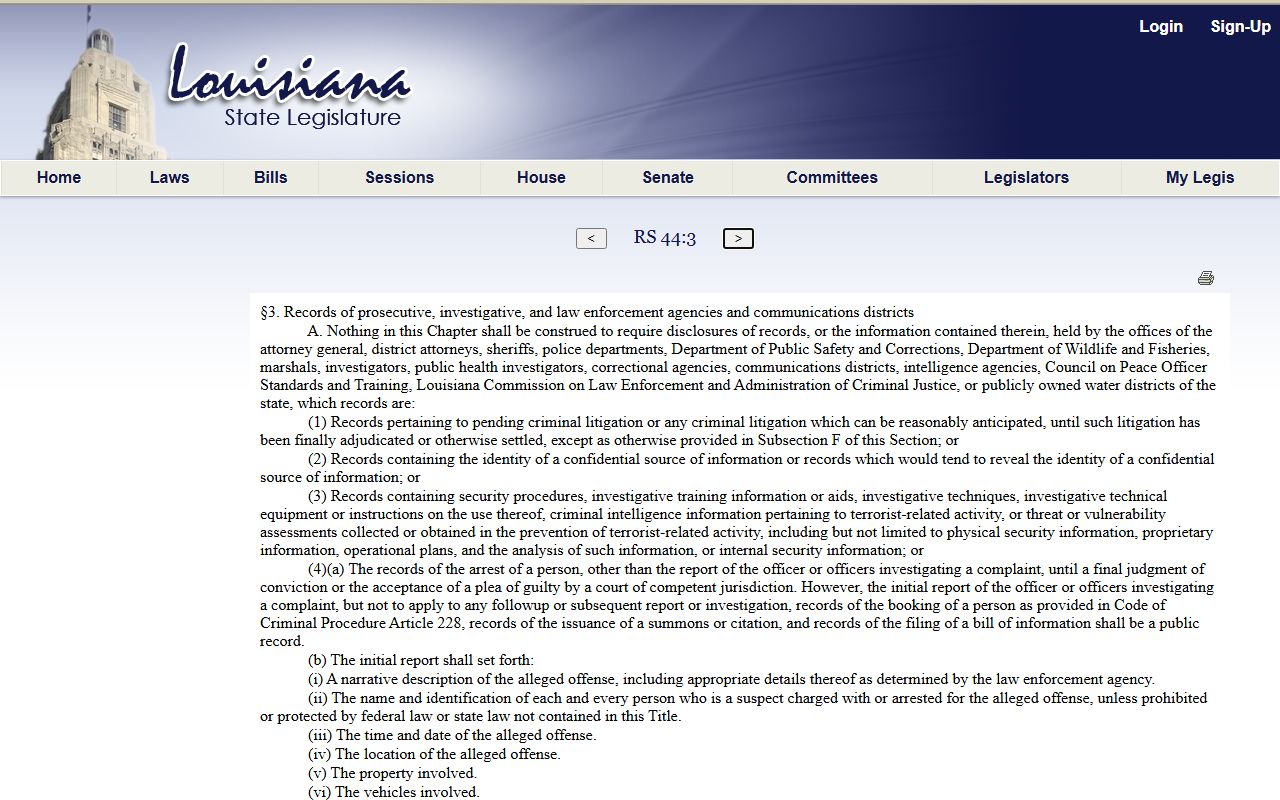
That statute explains why a filed court charge may be public while some investigative material remains restricted.
Note: Criminal court records are not consumer reports and should be verified with the Clerk before formal use.
Richland Parish Criminal Court Roles
The District Attorney screens arrests and investigations for prosecution, files bills of information or presents cases for indictment, requests subpoenas, and participates in bond forfeiture, plea, trial, sentencing, and dismissal decisions. The official Louisiana Secretary of State elected-official lookup identifies Penny Douciere as District Attorney for the Fifth Judicial District, which covers Franklin, Richland, and West Carroll Parishes.
The District 5 public defender office covers the same three-parish district for appointed counsel in qualifying criminal cases. The public defender is not a general records office. Public-record and copy questions should go to the Clerk or Sheriff, depending on the custodian. A defendant who cannot afford counsel should use the court and public defender channels for representation questions, not a records request process.
Restricted Richland Parish Criminal Records
Some Richland Parish criminal court records can be withheld, sealed, redacted, or handled under special rules. Juvenile records, sealed cases, expunged matters, adoption-related criminal references, mental-health proceedings, protected victim information, minor names, Social Security numbers, and financial account numbers should not be treated as ordinary public search results. Ongoing law-enforcement investigative files may also be restricted even when later court filings become public.
The Clerk's expungement packet is the local starting point when a person seeks removal of eligible arrest or conviction information from public access. The motion is filed in the court with jurisdiction over the event. Agencies have a chance to respond, and a judge signs the order if the legal requirements are met. The page should never state that an expungement destroys the record, because Louisiana law defines it as removal from public access.
The official Louisiana expungement definitions statute defines expungement for Richland Parish criminal court record access.
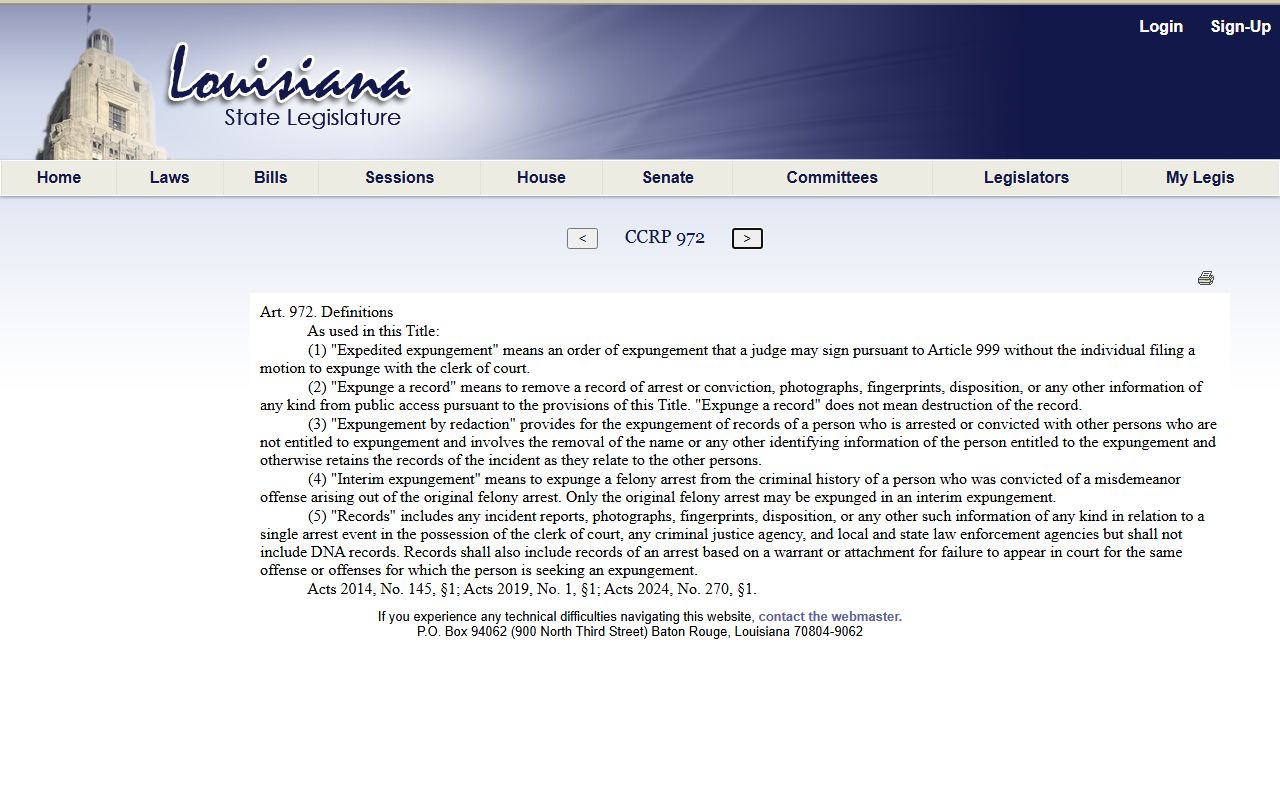
The definition matters because expungement changes public access rather than erasing the court or agency record.
Richland Parish Criminal Record Requests
For district court criminal case files, contact the Richland Parish Clerk of Court at 708 Julia Street, Suite 103, Rayville, LA 71269. The official contact page lists phone (318) 728-4171, fax (318) 728-7020, email richlandparishcc@bellsouth.net, and weekday hours from 8:30 a.m. to 4:30 p.m., excluding holidays. A request should include the defendant name, case number if known, charge or offense if known, filing date or date range, and whether plain or certified copies are needed.
Richland Parish Clerk of Court Criminal Department
708 Julia Street, Suite 103
Rayville, LA 71269
(318) 728-4171
Monday-Friday, 8:30 a.m.-4:30 p.m.